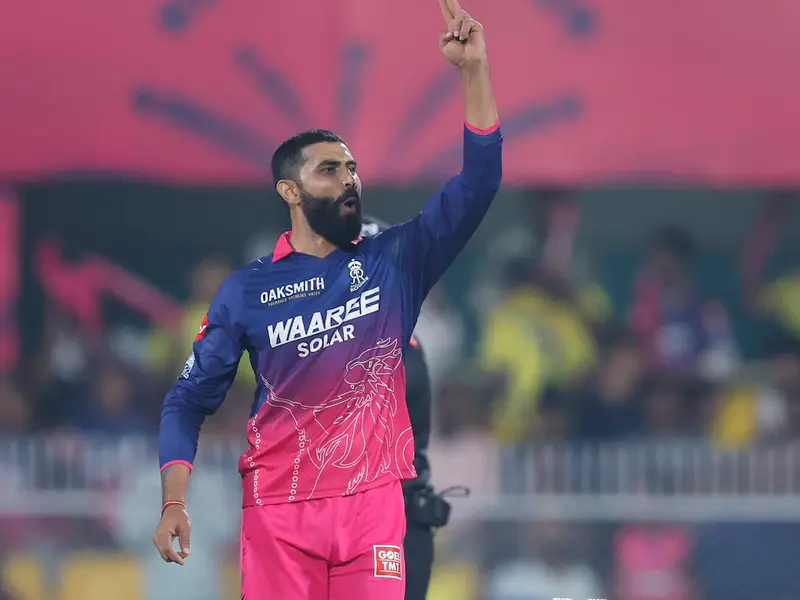
When news of the trade between Rajasthan Royals and Chennai Super Kings broke—sending Ravindra Jadeja to RR and Sanju Samson to CSK—the initial verdict strongly favoured Chennai.
From a long-term perspective, the move seemed logical. Samson was a key figure in India’s T20I setup and had just delivered a standout performance, earning Player of the Tournament honours as India defended their T20 title in Ahmedabad. Jadeja, on the other hand, had stepped away from T20 internationals after the 2024 triumph, raising doubts about his effectiveness in the format’s evolving, power-hitting landscape.
Those concerns were understandable. T20 cricket has increasingly become a batter-dominated game, often leaving traditional all-rounders searching for a clearly defined role. Yet, as IPL 2026 has already begun to show, experience and class still hold immense value.
In Guwahati, on a pitch that appeared more suited to seamers, Jadeja quietly reasserted his importance. While the pacers grabbed early attention, he made his mark through control and intelligence—proving that conditions don’t always dictate impact.
There was no dramatic overhaul to his approach. Instead, Jadeja relied on the fundamentals that have long defined his success—subtle variations in pace, consistent accuracy, and a sharp understanding of match-ups.
His dismissal of Sarfaraz Khan highlighted this perfectly. By slightly reducing his pace, Jadeja induced a mistimed shot, catching the batter off guard. Against Shivam Dube, a known power-hitter against spin, the contest was even more intriguing.
After being hit for a six, Jadeja responded immediately. He adjusted his length and line, forcing Dube to play away from his strengths, and within moments, turned the tide in his favour with a crucial wicket.
Reflecting on his performance, Jadeja said, “I think pink looks good on me. I’ve bowled to Shivam Dube in the nets, so I understand his approach. I tried to bowl outside off, knowing he would go for big shots. The wicket was slightly sticky and offered turn, so I focused on hitting the right areas.”
That insight underlines Jadeja’s enduring value in T20 cricket. In a format often defined by aggression, he thrives on discipline and precision. He doesn’t rely on extravagant spin or mystery deliveries—just control, awareness, and execution.
Encouragingly, there are also signs of evolution. In training, Jadeja has been seen experimenting with a carrom ball—something not typically associated with his bowling. It may not yet be a regular weapon, but it signals his intent to keep adapting.
Even at this stage of his career, Jadeja is not standing still. Instead, he continues to evolve, proving that true class not only survives but thrives in the ever-changing demands of T20 cricket.