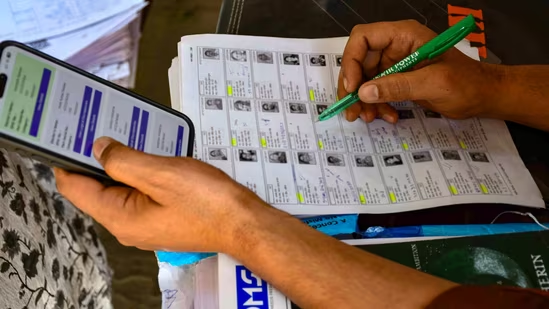
Concerns emerge after districts and constituencies with larger Muslim populations recorded higher voter deletions during the adjudication phase.
Has the Special Intensive Revision (SIR) of electoral rolls in West Bengal, particularly its adjudication process, reshaped the state’s electorate ahead of the upcoming Assembly elections? The question has gained attention as several districts and assembly constituencies (ACs) with larger Muslim populations reportedly witnessed higher voter deletions during the revision exercise.
The concern stems partly from political voting patterns. Muslim voters in the state have historically shown limited support for the Bharatiya Janata Party and are more likely to back the All India Trinamool Congress. As a result, any disproportionate removal of voters from such constituencies could potentially affect electoral outcomes. However, determining whether the revision amounts to electoral gerrymandering requires a more detailed statistical examination.
Earlier analyses suggested that the SIR process does not necessarily reduce the absolute number of voters. When the revision was first implemented in Bihar, post-SIR voter numbers were lower than the pre-revision electoral roll but still higher than the number of people who had actually voted in the previous election. Many of the removed names were believed to belong to deceased individuals, migrants, or voters registered at multiple locations. This cleaning of electoral rolls also resulted in a statistical rise in voter turnout during the 2025 Bihar elections. Similar patterns were later observed in Kerala and Assam, where electoral roll revisions were conducted.
In Bengal, the revised electoral roll still contains significantly more registered voters than the number of people who participated in the 2024 Lok Sabha election. However, for the total number of votes cast in the upcoming Assembly election not to fall below that level, voter turnout would need to increase substantially—from 81.7% in 2021 to about 88.9% in 2026, which would mark a record turnout for the state.
Constituency-level data also highlights notable trends. Reports suggest that voter deletions during the adjudication phase were more uneven than deletions recorded before adjudication under the SIR process. This pattern is particularly visible in two types of constituencies where community identity plays a stronger political role.
Among 67 constituencies that have elected at least one Muslim MLA since 2011, the proportion of deletions during adjudication was higher than their share in earlier electoral rolls. A similar pattern appears in 16 constituencies associated with the Matua community, a group of Dalit migrants whose roots trace back to present-day Bangladesh. In many of these constituencies, the Matua Mahasangha has a strong presence, and nine of them are reserved for Scheduled Castes.
The number of registered voters for the 2026 election has already fallen below the 2024 level in three constituencies—Metiaburuz in South 24 Parganas district, and Lalgola and Samserganj in Murshidabad district. In the 2024 Lok Sabha elections, the All India Trinamool Congress led in Metiaburuz, while the Indian National Congress led in the other two constituencies.
More broadly, 96 assembly constituencies now have less than a 10% difference between the latest number of electors and the votes cast in the 2024 Lok Sabha election. Simulations indicate that turnout would need to exceed 90% in 121 constituencies for the total votes cast in 2026 to match the 2024 parliamentary election. Among these are 29 Muslim-dominated constituencies and 15 Matua-dominated seats.
Is There Electoral Gerrymandering?
At present, it is difficult to reach a definitive conclusion about elector-level gerrymandering without detailed data on the religious composition of the electoral rolls before and after the SIR process. However, some statistical inferences can still be drawn.
Data shows that many Muslim-dominated constituencies were in the lower half of turnout rankings in the 2024 election, while several Matua-dominated constituencies recorded relatively higher participation. This could suggest two possibilities: either earlier electoral rolls in some Muslim-majority constituencies contained more inactive or duplicate voters, or the likelihood of electing a Muslim representative reduced the urgency among voters to turn out in large numbers.
With the upcoming elections taking place amid higher voter deletions in some of these constituencies, turnout patterns could shift. Muslim voters, in particular, may be more motivated to participate in the next election.
A clearer picture of the impact of the revision process will emerge only after constituency-wise turnout data from the Assembly elections becomes available.