

The Heartbeat of a Planet: Artemis II Returns to Ignite a New Age of Discovery
"The Future is Ours to Win" Reflecting on the monumental achievement, NASA Associate Administrator Amit Kshatriya emphasized the global effort behind the mission: "This victory belongs to the thousands of people across fourteen countries who built, tested, and trusted this vehicle. Their work protected four human lives traveling at 25,000 miles per hour. Artemis II proved the vehicle, the teams, and the international partnership. Reid, Victor, Christina, and Jeremy carried the hopes of this world farther than humans have traveled in more than half a century."Let's run that back. One more time... Or two? Our crew is now safely back on Earth. Relive the historic mission, and keep an eye on our website as more images and videos keep rolling in. https://t.co/FoYXKVvve5 pic.twitter.com/svDaL8ZXpc
— NASA (@NASA) April 11, 2026
Proving the Vehicle: Deep Space Testing For the first time with astronauts aboard, engineers put the Orion spacecraft through a rigorous in-flight evaluation. The mission served as a high-stakes "shakedown" to ensure Orion is ready for the lunar landings ahead. Key Technical Milestones: Life Support Systems: Confirmed Orion’s ability to sustain human life in the harsh environment of deep space. Manual Piloting: Crew members took the stick for several piloting demonstrations, validating Orion’s handling for future docking maneuvers with lunar landers. Operational Readiness: Tests were conducted on crew exercise routines, emergency procedures, and the Orion Crew Survival System spacesuits.LIVE: They are coming home. Watch as the Artemis II crew returns to Earth, splashing down at around 8:07pm ET (0007 UTC April 11). https://t.co/n3vZE2rcFv
— NASA (@NASA) April 10, 2026
 Science at the Moon’s Edge
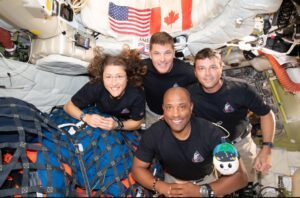
While orbiting the Moon, Commander Reid Wiseman, Pilot Victor Glover, and Mission Specialists Christina Hammock Koch and Jeremy Hansen conducted critical scientific research.
Human Health in Deep Space
The crew participated in the AVATAR investigation, a study focusing on how human tissue reacts to microgravity and deep-space radiation. These performance studies are essential for planning the multi-year missions required to reach Mars.
A New Perspective of the Lunar Surface
During a lunar flyby on April 6, the crew captured 7,000+ high-resolution images, including:
A rare solar eclipse from the Orion vantage point.
"Earthrise" and "Earthset" sequences.
Detailed topography of the lunar terminator (the day-night line), providing lighting data similar to the conditions at the
Lunar South Pole.
Impact flashes from meteoroids hitting the lunar night side.
What’s Next? The Road to Artemis III
The success of Artemis II serves as the springboard for Artemis III, scheduled for next year. While Artemis II tested the spacecraft and crew's endurance, Artemis III will see a new crew test integrated operations with commercially built Moon landers in low Earth orbit before heading for a surface landing.
The Long-Term Vision
NASA’s "Golden Age of Innovation" isn't just about a single landing.
The agency is actively building toward:
A Sustained Moon Base: Establishing a permanent human presence.
Economic Benefits: Leveraging lunar resources and international trade.
The Journey to Mars:
Using the Moon as a proving ground for the first human mission to the Red Planet.
"Fifty-three years ago, humanity left the Moon," Kshatriya noted. "This time, we returned to stay."
The success of Artemis II demonstrates that humanity is not just returning to the Moon—but preparing to stay, explore deeper, and push the boundaries of what’s possible.
With Artemis III on the horizon, the dream of a permanent lunar presence—and eventually human missions to Mars—is closer than ever before.
Image Credit, :NASA
Science at the Moon’s Edge
While orbiting the Moon, Commander Reid Wiseman, Pilot Victor Glover, and Mission Specialists Christina Hammock Koch and Jeremy Hansen conducted critical scientific research.
Human Health in Deep Space
The crew participated in the AVATAR investigation, a study focusing on how human tissue reacts to microgravity and deep-space radiation. These performance studies are essential for planning the multi-year missions required to reach Mars.
A New Perspective of the Lunar Surface
During a lunar flyby on April 6, the crew captured 7,000+ high-resolution images, including:
A rare solar eclipse from the Orion vantage point.
"Earthrise" and "Earthset" sequences.
Detailed topography of the lunar terminator (the day-night line), providing lighting data similar to the conditions at the
Lunar South Pole.
Impact flashes from meteoroids hitting the lunar night side.
What’s Next? The Road to Artemis III
The success of Artemis II serves as the springboard for Artemis III, scheduled for next year. While Artemis II tested the spacecraft and crew's endurance, Artemis III will see a new crew test integrated operations with commercially built Moon landers in low Earth orbit before heading for a surface landing.
The Long-Term Vision
NASA’s "Golden Age of Innovation" isn't just about a single landing.
The agency is actively building toward:
A Sustained Moon Base: Establishing a permanent human presence.
Economic Benefits: Leveraging lunar resources and international trade.
The Journey to Mars:
Using the Moon as a proving ground for the first human mission to the Red Planet.
"Fifty-three years ago, humanity left the Moon," Kshatriya noted. "This time, we returned to stay."
The success of Artemis II demonstrates that humanity is not just returning to the Moon—but preparing to stay, explore deeper, and push the boundaries of what’s possible.
With Artemis III on the horizon, the dream of a permanent lunar presence—and eventually human missions to Mars—is closer than ever before.
Image Credit, :NASA Related News
 OCT 19, 2026
Maharashtra CM Devendra Fadnavis Says Tiger Shroff Firing Accused to Be Arrested Soon
Maharashtra CM Devendra Fadnavis says the Mumbai Police have identified suspects in the firing incident targeting Tiger Shroff and will soon arrest those involved while tracking down the alleged masterminds.
 OCT 19, 2026
Marco Rubio Says US Is ‘Very Close’ to Finalising Trade Deal With India
US Secretary of State Marco Rubio says Washington is very close to finalising a trade deal with India, while explaining the impact of Russian oil sanctions on global energy supplies and prices.
 OCT 19, 2026
Eknath Shinde Meets Tiger Shroff After Firing, Warns Gangs of Strong Response
Maharashtra Deputy CM Eknath Shinde has vowed strict action against criminal gangs after unidentified assailants opened fire at Tiger Shroff’s car in Mumbai. The actor escaped unhurt, while two others were reportedly injured.
 OCT 19, 2026
Eknath Shinde Condemns Firing Incident Targeting Tiger Shroff
Maharashtra Deputy Chief Minister Eknath Shinde has condemned the firing incident targeting Tiger Shroff’s vehicle and said Mumbai Police have formed multiple teams to apprehend those responsible.
Comments (0)