

ISRO Successfully Launches NVS-03 Navigation Satellite on GSLV-F18
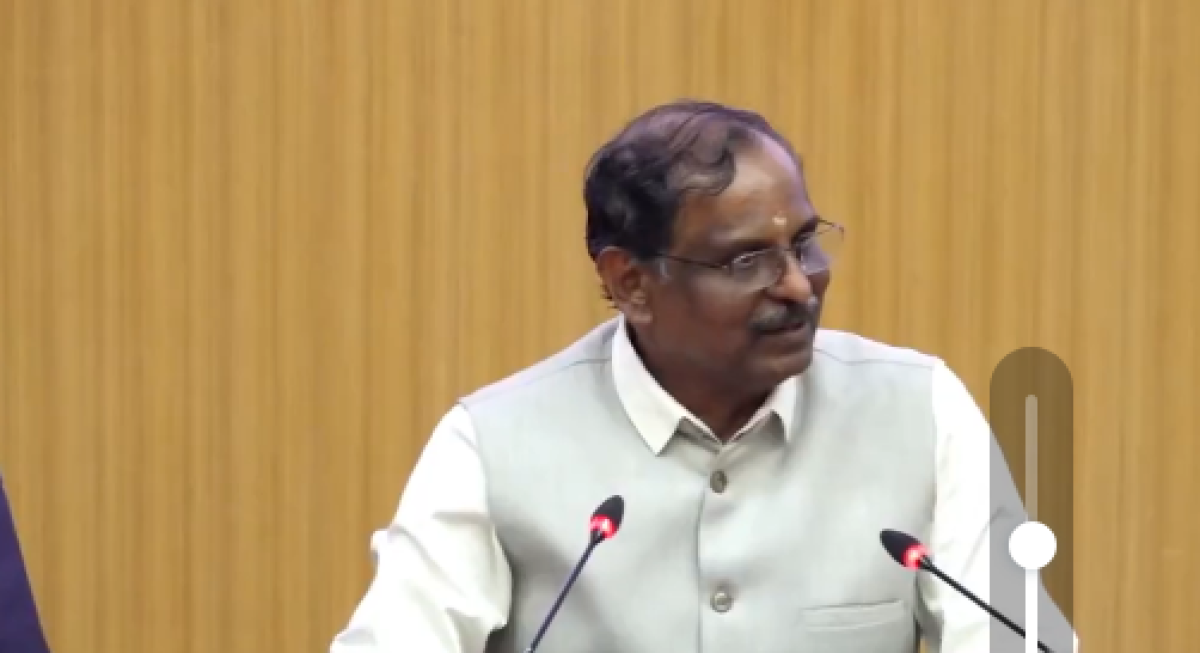
The Indian Space Research Organisation has successfully launched the NVS-03 navigation satellite aboard GSLV-F18, with ISRO Chairman Dr. V. Narayanan saying the spacecraft was placed into the required orbit with very high precision.
The mission lifted off from the Satish Dhawan Space Centre, Sriharikota, and successfully placed NVS-03 into a Geosynchronous Transfer Orbit.
ISRO Chief Highlights Precise Orbital Injection
Speaking after the successful ISRO NVS-03 launch, Narayanan said the GSLV-F18 vehicle had injected the satellite into its targeted orbit with what he described as exceptional accuracy.
He said:
“The GSLV F18 vehicle has successfully and precisely injected the NVS03 navigation satellite into the required precise orbit.”
Narayanan cited the achieved perigee and apogee figures while highlighting the precision of the mission.
According to him, the perigee achieved was about 170.31 km, compared with a targeted 170.36 km.
He also said the mission achieved a highly accurate transfer orbit, describing the performance as among the best achieved by a launch vehicle.
20th Launch of GSLV
The mission marked the 20th flight of India’s Geosynchronous Satellite Launch Vehicle.
ISRO’s official launch records confirm that GSLV-F18/NVS-03 was the 20th GSLV mission.
Narayanan said that across its missions, the GSLV programme has carried a cumulative spacecraft mass of around 34 tonnes into orbit.
Shortest Turnaround Between GSLV Missions
The ISRO chief also highlighted the short interval between GSLV-F17 and GSLV-F18.
ISRO records show GSLV-F17/EOS-05 launched on September 4, 2026, followed by GSLV-F18/NVS-03 on October 30, making the gap 56 days.
Narayanan described this as the shortest turnaround achieved between two GSLV launches.
NVS-03 Strengthens NavIC Constellation
NVS-03 is part of India’s second-generation navigation satellite series designed to strengthen NavIC, the country’s indigenous regional navigation system.
ISRO says the satellite carries an indigenous atomic clock, along with procured atomic clocks, and supports L1 signals in addition to the existing L5 and S-band navigation signals.
The satellite is designed to serve India and an area extending approximately 1,500 km beyond the country’s geographical boundaries.
Four-Satellite Navigation Capability Restored
Narayanan said three navigation satellites were already operational and that NVS-03 would become the fourth satellite in the functioning constellation.
He said a minimum of four satellites is needed for reliable positioning, navigation and timing services, and that the latest launch would help restore that capability.
ISRO’s spacecraft status page lists IRNSS-1I and NVS-01 as operational for positioning, navigation and timing services, while NVS-02 is currently listed as not operational.
PM Modi Congratulates ISRO
Prime Minister Narendra Modi congratulated ISRO scientists and engineers after the successful mission.
He said NVS-03 would strengthen NavIC, support India’s pursuit of self-reliance in critical technologies and improve navigation services for citizens.
NavIC Gets Fresh Boost
The successful ISRO NVS-03 launch strengthens India’s independent navigation infrastructure at a time when satellite-based positioning, transport tracking, maritime navigation and strategic applications are becoming increasingly important.
The mission also adds momentum to ISRO’s GSLV programme after a rapid turnaround from its previous launch.
Related News
Dhubri detention: police question 36 suspected Bangladeshi nationals
Police said 36 men were detained at Jogamaya Ferry Ghat after arriving by boat. Their route and destination remain under investigation.
 OCT 31, 2026
Tata Motors acquires 89.42% Iveco stake; Chandrasekaran named chair
Tata Motors said the initial tender settlement brought Iveco into the group. A further settlement is scheduled for November 13.
 OCT 31, 2026
Indian-American voters courted through dosas, Diwali and temple visits
US candidates are turning to cultural events and community visits as they seek Indian-American support in competitive midterm contests.
 OCT 30, 2026
KG basin dispute: Supreme Court appoints Ranjana Desai mediator
KG basin dispute moves to mediation under former judge Ranjana Prakash Desai after parties failed to reach a solution, the Supreme Court said.
Comments (0)