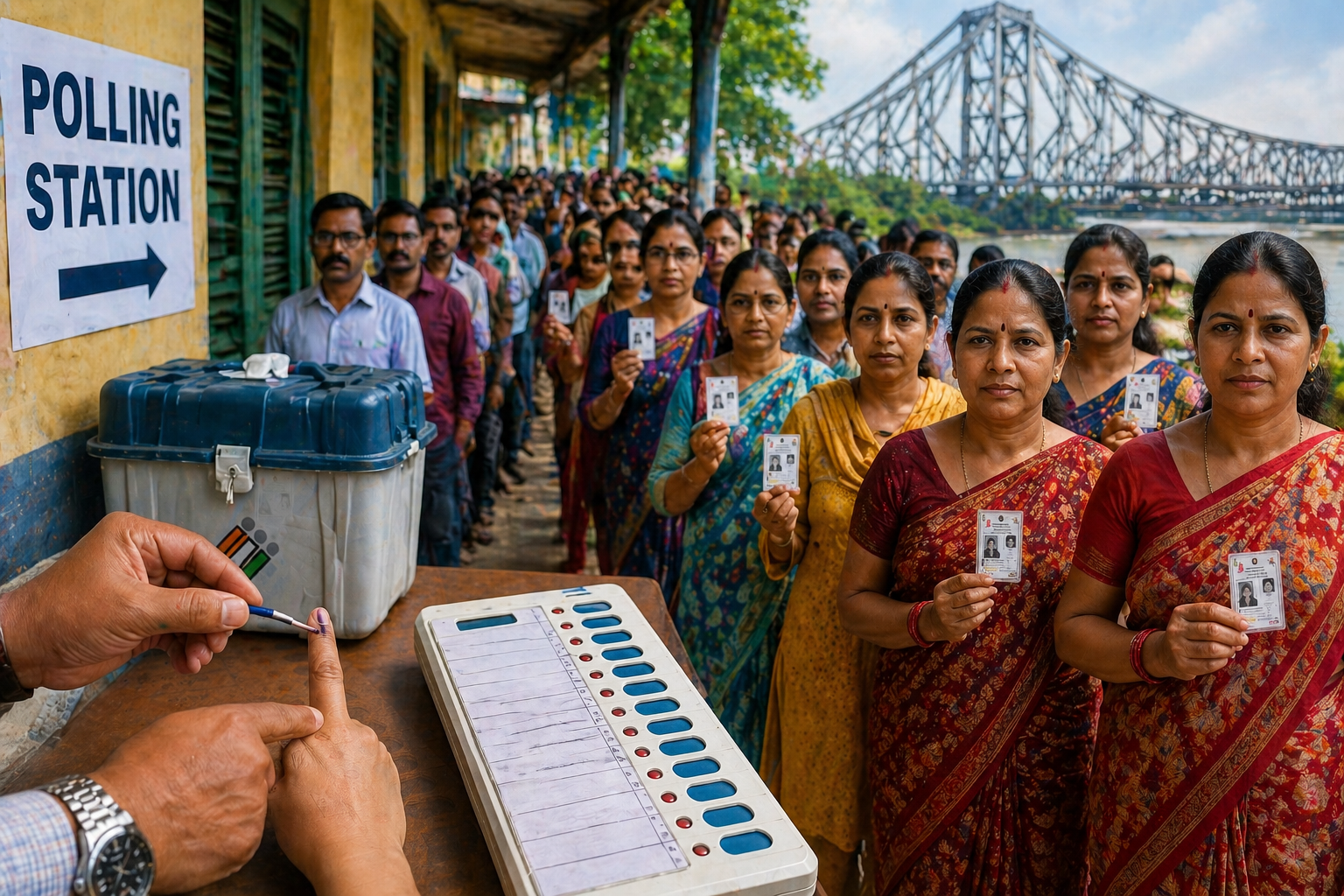
Over 61 per cent of the 3.21 crore electorate exercised their franchise till 1 pm during the second and final phase of polling in West Bengal, reflecting strong voter participation across key districts despite sporadic incidents of unrest.

Long queues were seen outside polling booths from as early as 7 am in Kolkata, Howrah, Hooghly, Nadia, North and South 24 Parganas, and Purba Bardhaman—regions considered the political heartland of the state.
According to official data, 61.11 per cent voter turnout was recorded till early afternoon. Purba Bardhaman led with the highest polling at 66.8 per cent, followed by Hooghly (64.57 per cent) and Nadia (61.41 per cent). Howrah registered 60.68 per cent, while North 24 Parganas recorded 60.18 per cent turnout.
In Kolkata, turnout figures stood at 60.18 per cent in the north and 57.73 per cent in the south. South 24 Parganas, a politically significant district with several high-profile contests, recorded 58.58 per cent voting.
Out of the total electorate, approximately 1.57 crore are women voters, while 792 belong to the third-gender category, highlighting the diverse voter base participating in the democratic process.
Tension briefly flared in the Bhawanipur constituency as Chief Minister Mamata Banerjee and BJP leader Suvendu Adhikari exchanged sharp remarks within the same booth area, drawing attention to the high-stakes nature of the contest.
Despite isolated incidents, election authorities maintained that polling remained largely peaceful. “Polling is underway peacefully, barring some minor incidents. We have sought reports from the officials concerned,” a poll panel official stated.
The second phase marks a crucial battle in southern Bengal, traditionally a stronghold of the ruling Trinamool Congress. In the 2021 assembly elections, the party secured 123 out of 142 seats in this region, while the BJP managed 18 seats and the ISF won one.
For the BJP, making inroads into this region is vital to mounting a serious challenge for power, while the TMC aims to consolidate its dominance in its core electoral base.