

Samsung Drops Its Ambitious Galaxy Z TriFold Just Three Months After Launch: What It Means for Triple-Fold Phones
Samsung Discontinues Galaxy Z TriFold Just Months After Launch, Casting Doubt on Triple-Fold Phones
Samsung has officially discontinued its ultra-premium Galaxy Z TriFold, just a few months after the device made its global debut at CES in Las Vegas earlier this year. The decision to pull the plug on the ambitious triple-folding smartphone raises questions about the future of experimental devices in an increasingly challenging market.
According to a recent report, Samsung has halted production of the Galaxy Z TriFold, which was priced at around $2,899 (approximately ₹2.6 lakh) in select markets such as the US and South Korea. The company later confirmed the move, while its US website had already stopped showing restock updates, listing the device as “sold out”—an early indication of its discontinuation.
A Short-Lived Global Rollout
The Galaxy Z TriFold was first introduced in South Korea late last year before expanding to markets like Singapore, China, Taiwan, and the UAE. Its US launch was announced at CES, positioning the device as Samsung’s bold step into the next phase of foldable innovation.
Although Samsung is the world’s largest smartphone maker, it wasn’t the first to introduce a triple-folding phone. That distinction belongs to Huawei, which had already experimented with the form factor. However, Samsung’s entry into the global market signalled broader ambitions for the category.
High Price, Early Issues
Despite its cutting-edge design—featuring dual inward-folding hinges that expand into a 10-inch display—the Galaxy Z TriFold struggled to gain traction. Its steep price tag alone limited its appeal, but reports of display issues further dented consumer confidence. Some users claimed the screen would stop functioning unexpectedly, a serious concern for a device in the ultra-premium segment.
Market Pressures and Strategy Shift
The discontinuation also comes amid a global memory and component cost crisis, which has forced smartphone manufacturers, including Samsung, to rethink their product strategies. With resources increasingly shifting toward AI-driven technologies and data centres, companies appear to be prioritising more commercially viable products over experimental hardware.
Industry sources suggest that Samsung had always planned a limited production run for the TriFold, reportedly between 20,000 and 30,000 units. Given its niche appeal and high production costs, continuing the device may not have made strong business sense.
Not the End of Foldables
While the Galaxy Z TriFold may be short-lived, it does not signal the end of foldable smartphones. Major brands like Samsung and Motorola are expected to continue investing in foldable technology. However, the focus is likely to shift toward more practical, widely accepted devices rather than high-risk experimental models.
Devices like Samsung’s Galaxy Z Fold series, which have already found a broader consumer base, are expected to remain central to the company’s foldable strategy going forward.
Related News
 OCT 11, 2026
IMC 2026: Scindia Highlights India’s AI Leadership
At IMC 2026, Union Communications Minister Jyotiraditya M. Scindia highlighted India’s role in shaping the future of AI through AI-native networks, the Bharat 6G Alliance, AI for Good and trustworthy Digital Public Infrastructure.
 OCT 9, 2026
Scindia Says India Won’t Allow SATCOM Monopoly
Union Minister Jyotiraditya Scindia says India will not allow a monopoly in satellite communications. Reliance Jio, OneWeb and Starlink have licences, while Amazon Project Kuiper is interested in entering the market.
 OCT 9, 2026
Trump Presents National Medal of Science to NVIDIA CEO Jensen Huang
US President Donald Trump presents the National Medal of Science to NVIDIA CEO Jensen Huang, recognising his contributions to AI, GPU computing, supercomputing and semiconductor innovation.
 OCT 9, 2026
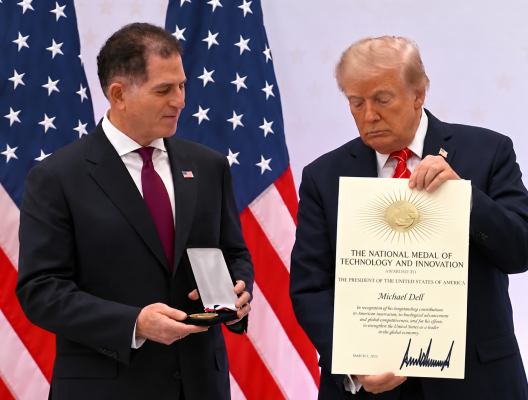
Trump Praises Michael Dell for Transforming Personal Computing
President Donald Trump has praised Michael Dell for transforming a $1,000 idea developed in his University of Texas dorm room into a revolution in personal computing.
Comments (0)