

Supreme Court Tells Delhi Police to Ensure Every Woman Feels Safe Even at 10 PM
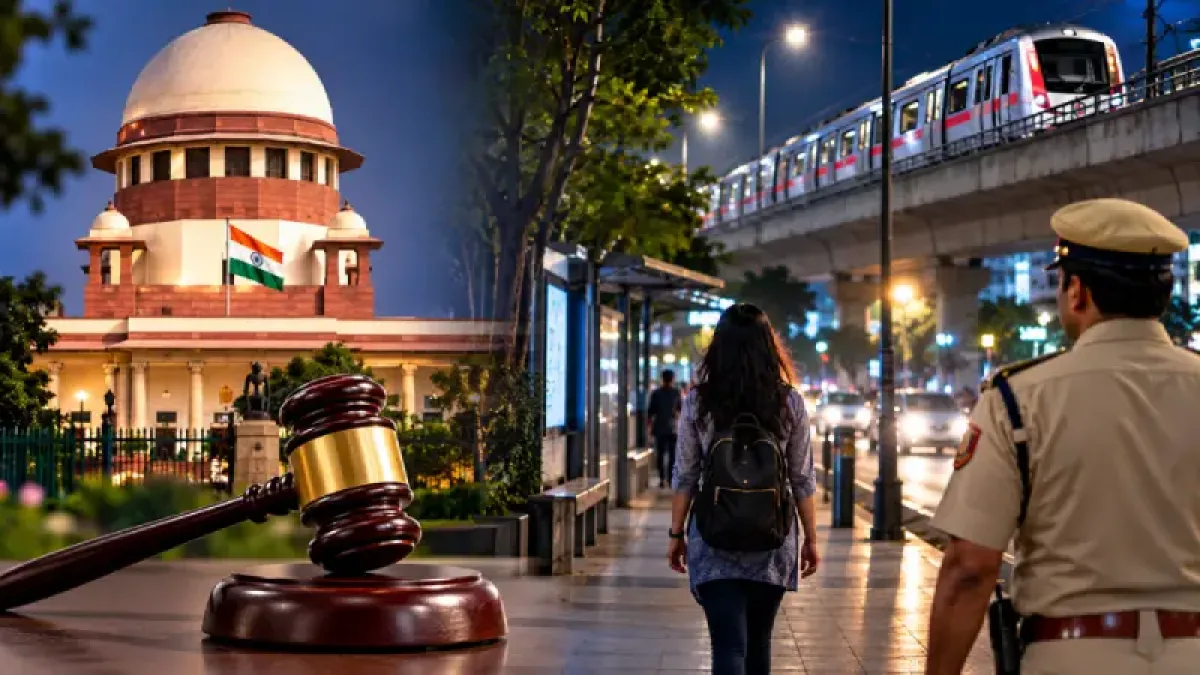
The Supreme Court on Monday called for stronger measures to ensure that every woman in Delhi feels safe while using public spaces and public transport, including at night.
A bench headed by Justice JB Pardiwala stressed the need for effective action by the Centre and Delhi Police while hearing a suo motu case concerning a series of recent rape and sexual assault cases in Delhi-NCR.
The court emphasised that women should be able to walk on the streets at 10 pm or travel by metro and road without fear.
Supreme Court Raises Concerns Over Women's Safety
The Supreme Court's intervention comes amid growing concerns over the safety of women and minors in the National Capital Region.
On September 28, the court had taken suo motu cognisance of several alleged sexual assault cases, including the alleged gang rape of a 17-year-old girl at Aastha Kunj Park near Kalkaji, the alleged gang rape of a minor in Swaroop Nagar and the alleged sexual assault of a 16-year-old girl inside a bus travelling from Greater Noida to Delhi.
The court had questioned whether adequate steps had been taken to protect women and children in public spaces.
It also observed that places such as parks, roads and buses cannot be allowed to become high-risk areas for women. The bench referred to the lessons of the 2012 Nirbhaya case and linked public safety with the fundamental right to live with dignity and without violence under Article 21 of the Constitution.
Aastha Kunj Case Puts Delhi Parks Under Scrutiny
The alleged gang rape of a 17-year-old girl at Aastha Kunj Park on September 21 has triggered renewed concerns over security arrangements in Delhi's parks.
A subsequent safety audit by the Delhi Development Authority found significant gaps in surveillance and infrastructure across its parks.
Of the 736 DDA-managed parks covered by the audit, only 16 had CCTV cameras. The assessment identified 190 parks as high-risk, while 520 parks were found to require additional lighting and 323 were identified as needing additional CCTV cameras.
The audit also highlighted concerns involving park boundaries, gates, toilets and abandoned structures that could create security risks.
At Aastha Kunj, authorities have identified more than 30 locations for CCTV installation. Officials have also pointed to the park's secluded stretches and wooded areas, which can make monitoring and surveillance more difficult.
Court Questions Systemic Safety Gaps
The Supreme Court has raised concerns about what it described as a wider failure to ensure basic public safety in the national capital.
The court has called for an assessment of vulnerable public spaces and stronger preventive measures, including better surveillance, lighting and security arrangements.
The focus is not only on investigating crimes after they occur but also on identifying locations where women and children may be particularly vulnerable and taking steps to prevent offences.
Women's Safety Should Not Mean Restrictions
The debate over women's safety in Delhi has also raised questions about whether restrictions on women's movement can ever be considered a solution.
Delhi Chief Minister Rekha Gupta has said that ensuring women's safety should not mean restricting the freedom of girls and women.
Instead, she has called for improved lighting, wider CCTV coverage and additional security personnel at vulnerable locations. She has also stressed the need to expedite cases involving women and girls.
The approach reflects a broader demand for safer public spaces rather than restrictions on when or where women can travel.
Delhi Authorities Face Pressure to Improve Security
The Supreme Court's latest observations put renewed pressure on the Centre, Delhi Police and civic authorities to address security gaps across the capital.
Recent incidents have highlighted vulnerabilities in parks, roads and public transport, raising questions about whether existing preventive measures are sufficient.
The court's message is that women's safety cannot be limited to certain hours of the day. A woman should be able to walk through Delhi at 10 pm, use public transport or travel on the road without feeling threatened.
Strengthening policing, improving lighting, expanding CCTV surveillance and securing vulnerable public spaces will therefore remain key to making Delhi safer for women.
Related News
 OCT 25, 2026
PM Modi Hails India’s Record 114 Asian Para Games Medals
Prime Minister Narendra Modi hails India’s para-athletes for securing a record 114 medals at the Asian Para Games 2026, calling it a moment of immense national pride and joy.
 OCT 25, 2026
Donald Trump Says France Is ‘Burning Down’ Over Its Open-Border Policy
US President Donald Trump has criticised France’s immigration policies, claiming that open borders are contributing to serious problems and urging countries to prevent the entry of people he considers a threat to national interests.
 OCT 25, 2026
CM Devendra Fadnavis Launches Navi Mumbai Projects
Maharashtra CM Devendra Fadnavis launches infrastructure development works in the NAINA region, inaugurates key connectivity projects near Navi Mumbai International Airport and distributes property cards to landholders.
 OCT 25, 2026
Trump Says Biden Should Have Asked Europe to Fund Ukraine Aid
US President Donald Trump has criticised the distribution of Ukraine aid under Joe Biden, arguing that European allies could have paid a greater share of the cost. His remarks have reignited debate over military assistance, transatlantic cooperation and burden-sharing in the war against Russia.