

‘Banglar Bari’, Releases Second Installment to Nearly One Million Beneficiaries
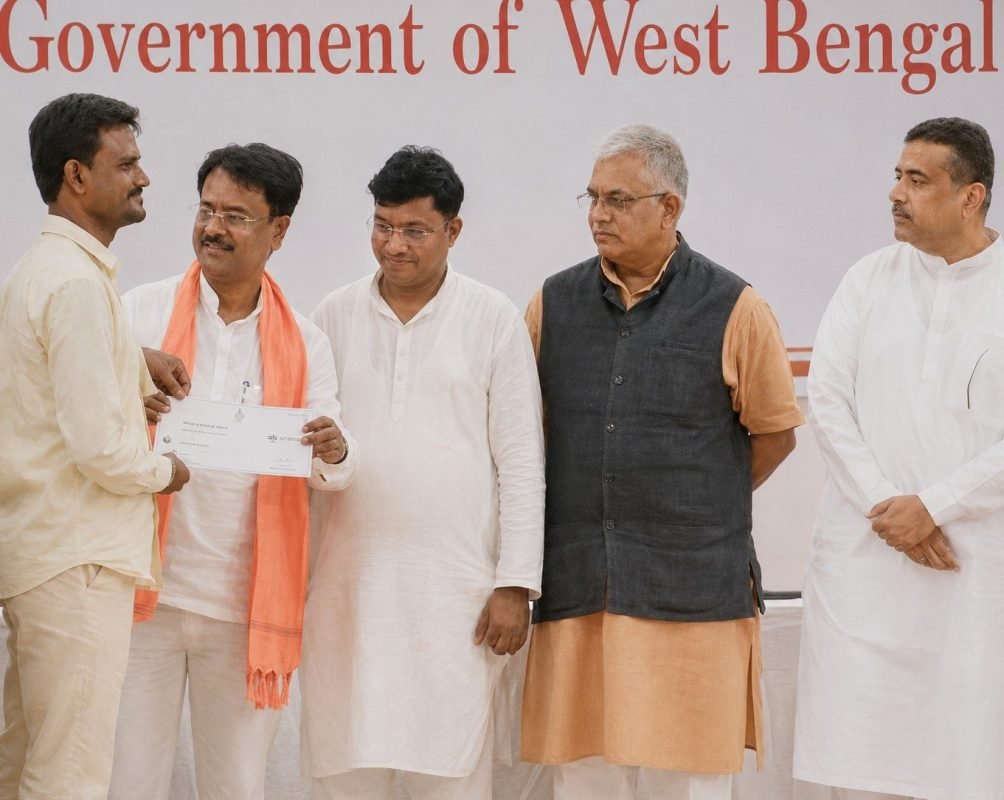
Paschim Banga Awas has officially become the new name of West Bengal's flagship rural housing scheme after the state government announced a major policy overhaul on Thursday. Alongside the renaming of the programme, the government released the second installment of financial assistance to nearly one million beneficiaries, reaffirming its commitment to providing permanent housing to eligible rural families.
Hon'ble Chief Minister Shri Suvendu Adhikari inaugurated the Paschimbanga Abas scheme.
— Chief Minister's Office, Govt. of West Bengal (@cmowbgov) August 6, 2026
Launching the programme from Nabanna Sabhaghar, he symbolically handed over cheques to eligible beneficiaries. Direct financial assistance of approximately ₹6,122 crore will be credited to… pic.twitter.com/laUvr5FzXd
The announcement was made by Chief Minister Suvendu Adhikari during a state-level event attended by senior ministers, bureaucrats, and government officials. The Chief Minister said the scheme represents the government's commitment to ensuring that housing assistance reaches only genuine beneficiaries through a transparent verification process.
Banglar Bari Renamed as Paschim Banga Awas
One of the biggest announcements at the programme was the decision of the State Cabinet to rename the Banglar Bari housing scheme as Paschim Banga Awas.
The Chief Minister said the new name reflects the government's vision of implementing welfare programmes in coordination with the Central Government. He criticised the previous administration for allegedly politicising welfare schemes and claimed that the current government is focused on delivering benefits without political considerations.
According to the Chief Minister, welfare schemes should represent the government and the people rather than being associated with any individual.
Second Installment Released to Nearly One Million Beneficiaries
Under the Paschim Banga Awas scheme, the government has released the second installment of financial assistance to nearly one million beneficiaries.
Officials said the payments were made after an extensive verification exercise to ensure that only eligible applicants received assistance.
The Chief Minister thanked Panchayat Minister Dilip Ghosh for completing the verification process within three months, describing it as a major administrative achievement.
He reiterated that individuals found to be ineligible, including non-Indian citizens or those who obtained benefits fraudulently, would not receive financial assistance under the scheme.
Verification Drive Strengthens Transparency
The government stated that a comprehensive verification exercise was undertaken before releasing the funds.
According to officials, the objective was to:
Identify genuine beneficiaries
Remove fake or duplicate records
Prevent misuse of public funds
Ensure transparency in welfare delivery
Improve accountability in housing assistance
The administration said similar verification exercises would continue for future beneficiary lists.
Additional Support for Beneficiaries
The Chief Minister acknowledged that rising prices of cement, steel, and other construction materials have increased the cost of building houses.
To support beneficiaries, he announced that:
Eligible families will receive ₹12,000 for constructing household toilets after completing their houses.
Beneficiaries were encouraged to avail themselves of other Central Government welfare programmes, including the PM Surya Ghar Scheme, to reduce household expenses.
The government believes these additional benefits will improve the quality of housing and overall living conditions.
Housing Assistance Worth ₹30,000 Crore
According to the Chief Minister, nearly ₹30,000 crore has been released for approximately 4 million houses sanctioned up to March 31, 2022.
He appealed to all eligible families who have not yet enrolled under the housing programme to submit their applications.
The government assured that beneficiaries would be selected without discrimination based on:
Political affiliation
Religion
Caste
Social background
The Chief Minister also announced that the first installment would be released to several lakh additional beneficiaries after the Durga Puja festival.
Dilip Ghosh Highlights Verification Findings
Speaking at the event, Minister Dilip Ghosh said that under the previous Banglar Bari scheme:
Around 3 million beneficiaries were sanctioned housing assistance.
Approximately 1.2 million beneficiaries received the full financial assistance.
Nearly 1.8 million beneficiaries received only the first installment.
He further claimed that investigations identified nearly 12,500 beneficiaries who had allegedly received housing assistance illegally.
According to Ghosh, recovery proceedings have already begun against those found to have obtained benefits through irregular means.
He also stated that nearly 57,000 eligible individuals whose names were omitted during the Special Intensive Revision (SIR) of electoral rolls had also been excluded from the housing beneficiary list. He assured that their cases would be reviewed after verification.
Chief Secretary Emphasises Clean Implementation
Chief Secretary Manoj Agarwal said the housing programme was originally implemented under the Pradhan Mantri Gramin Awas Yojana (PMAY-G) before being renamed by the previous state government.
He alleged that allegations of corruption and irregularities had resulted in the suspension of Central assistance.
Following the Centre's Awas Plus Survey, nearly 1.866 million eligible beneficiaries have now been identified and will receive financial assistance in phases.
The Chief Secretary also announced a zero-tolerance policy against:
Corruption
Cut-money practices
Syndicate operations
Fraudulent beneficiary claims
A dedicated helpline has also been launched to receive complaints related to the implementation of the housing scheme.
Government Reaffirms Commitment to Rural Housing
The state government said Paschim Banga Awas will continue to focus on providing permanent housing to economically weaker rural families while maintaining transparency and accountability.
Officials believe the combination of digital verification, strict monitoring, and grievance redressal mechanisms will significantly improve the implementation of the housing programme.
The government also reiterated its commitment to ensuring that every eligible family receives housing assistance without political bias or administrative delays.
The launch of Paschim Banga Awas marks a significant policy shift in West Bengal's rural housing programme. Along with releasing the second installment of assistance to nearly one million beneficiaries, the government has introduced stricter verification measures aimed at ensuring transparency and preventing misuse of public funds.
With additional beneficiaries expected to receive assistance after Durga Puja, the scheme is set to remain one of the state's key welfare initiatives for rural housing.
Related News
 OCT 27, 2026
PM Modi Says ₹24,000 Crore Committed to India Research and Development in One Year
Prime Minister Narendra Modi said India secured ₹24,000 crore in new research and development commitments in one year while urging scientists to use AI without compromising independent thinking.
 OCT 27, 2026
Harry Kane Reflects on Unforgettable Ballon d’Or Triumph
Harry Kane calls his Ballon d’Or triumph an evening he will never forget, thanking his teammates, staff, family, friends and fans for their support.
 OCT 27, 2026
Madan Mitra Targets BJP Over Gaighata Police Encounter
Democratic Trinamool Congress leader Madan Mitra criticised the BJP after the accused in the Gaighata rape-murder case was killed in a police encounter in North 24 Parganas.
 OCT 27, 2026
Om Birla Calls for Peace, Justice at BRICS Parliamentary Forum 2026
Lok Sabha Speaker Om Birla said global peace must ensure security, dignity and justice for all as the 12th BRICS Parliamentary Forum concluded in New Delhi.