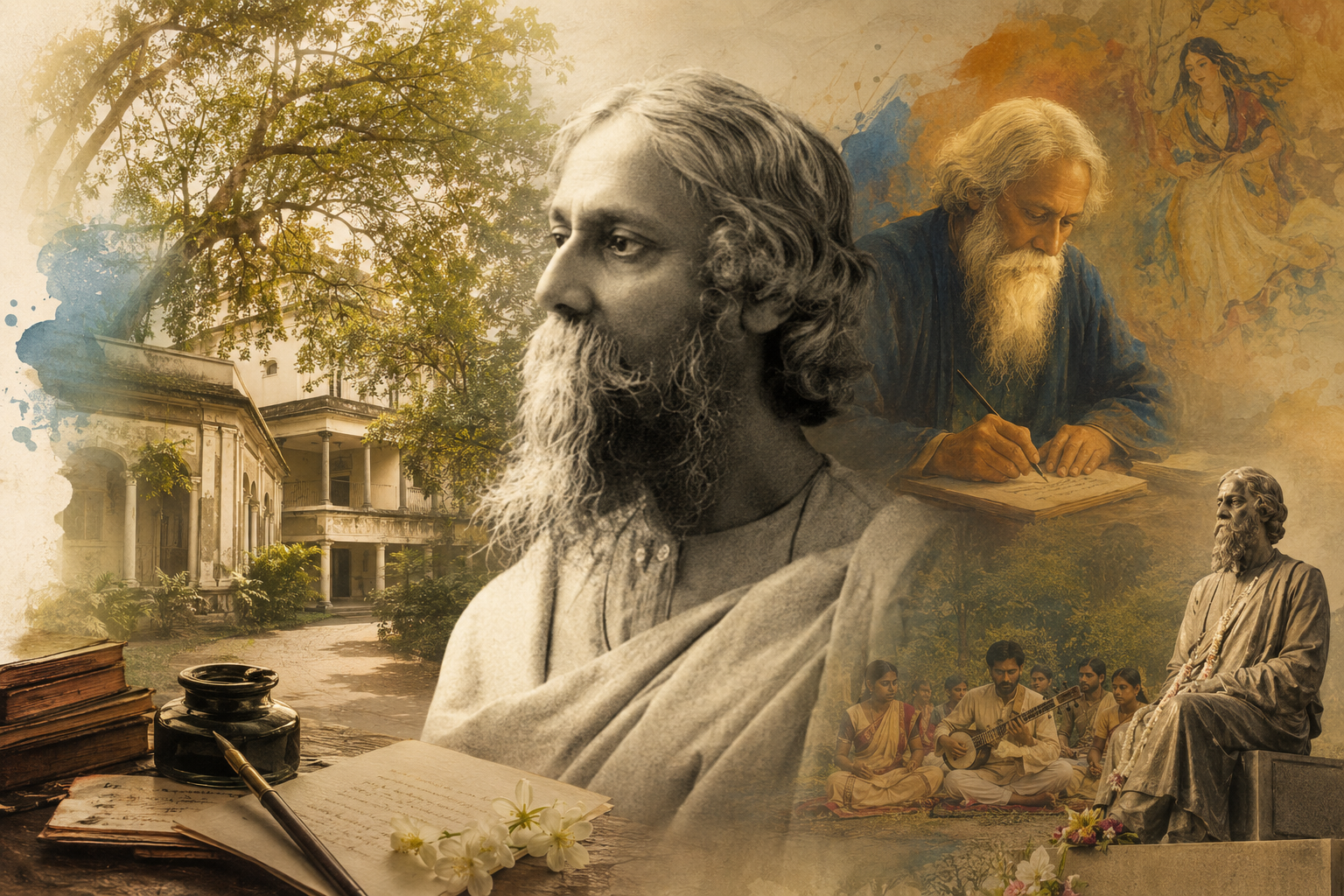
On this day, India doesn’t just remember a poet — it reconnects with its conscience.
The birth anniversary of Rabindranath Tagore is not merely a cultural observance; it is an emotional homecoming. A return to words that healed, awakened, and defined a civilization searching for its identity.
Tagore was not just the author of Jana Gana Mana or the Nobel Prize-winning creator of Gitanjali — he was the quiet force that gave India its voice before it found its freedom.
A Poet Who Felt Like a Nation
There are few figures in history who transcend time the way Tagore does. His words were not confined to ink and paper — they became emotion, resistance, and hope.
At a time when India was chained under colonial rule, Tagore chose neither rage nor silence. Instead, he wrote. And in writing, he liberated minds.
His poetry spoke of freedom long before it was won. His songs carried the pain and pride of millions. His ideas challenged blind nationalism while nurturing a deeper, more humane patriotism.
Tagore taught India how to feel — and more importantly, how to think.
Santiniketan: Where Education Became Freedom
In an era of rigid classrooms, Tagore imagined learning under open skies. At Visva-Bharati University in Santiniketan, education wasn’t about memorization — it was about discovery, creativity, and connection with nature.
He believed that true education must free the mind, not condition it.
Today, as education systems worldwide grapple with standardization and pressure, Tagore’s vision feels not just relevant — it feels necessary.
Why Tagore Still Matters Today
In a fast-moving, divided, and often noisy world, Tagore’s voice arrives like a quiet truth we didn’t know we needed.
When society feels fractured, his belief in universal humanism reminds us that identity must never overshadow humanity.
When nationalism turns aggressive, his caution against narrow thinking feels prophetic.
When creativity is boxed into algorithms, his celebration of imagination feels revolutionary.
Tagore doesn’t belong to the past — he belongs to every moment we choose empathy over ego, thought over noise, and creation over destruction.
More Than a Memory — A Living Legacy
From Rabindra Sangeet echoing through Bengali homes to global literary circles still studying his work, Tagore lives on — not as history, but as presence.
Every time a child sings with freedom.
Every time a writer dares to feel deeply.
Every time a nation pauses to reflect instead of react — Tagore breathes again.
“Where the mind is without fear…” — perhaps no line has captured the soul of India more powerfully.
On his birth anniversary, the question is not how we remember Tagore.
The question is — are we living what he dreamed?
Because Tagore’s relevance isn’t in statues or ceremonies.
It is in whether we still have the courage to think freely, feel deeply, and remain human in a world that often forgets how.