

Trump Issues Dire Warning to Iran: "A Whole Civilization Will Die Tonight" as Deadline Looms
 The Final Ultimatum
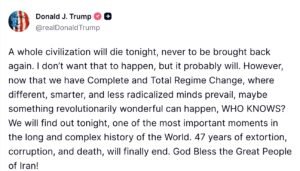
The President’s remarks come amidst a period of unprecedented tension. Following weeks of joint U.S.-Israeli strikes that began in late February—which reportedly resulted in the death of former Supreme Leader Ali Khamenei—Trump is now claiming that a "Complete and Total Regime Change" is underway.
In his latest post, Trump suggested that "smarter and less radicalized minds" are now in a position to shift the nation’s trajectory, though he remained fatalistic about the immediate survival of the current Iranian state.
Ending "47 Years of Extortion"
Trump’s rhetoric focused heavily on the legacy of the 1979 Revolution, stating that "47 years of extortion, corruption, and death will finally end."
The administration’s "Air Armada" has already targeted critical energy hubs, including Kharg Island, and military analysts suggest that the next wave of strikes could "obliterate" the country's power grid and bridge infrastructure within a four-hour window if Tehran does not capitulate.
Global Impact and Markets
The threat has sent global oil markets into a frenzy. With the Strait of Hormuz handling approximately 20% of the world’s oil and gas, any prolonged conflict or total closure threatens a global energy crisis. While Trump has dismissed concerns regarding potential war crimes, stating he is "not at all" concerned about the optics of destroying civilian infrastructure, world leaders in Europe and the Middle East are frantically calling for a de-escalation that seems increasingly unlikely
The Final Ultimatum
The President’s remarks come amidst a period of unprecedented tension. Following weeks of joint U.S.-Israeli strikes that began in late February—which reportedly resulted in the death of former Supreme Leader Ali Khamenei—Trump is now claiming that a "Complete and Total Regime Change" is underway.
In his latest post, Trump suggested that "smarter and less radicalized minds" are now in a position to shift the nation’s trajectory, though he remained fatalistic about the immediate survival of the current Iranian state.
Ending "47 Years of Extortion"
Trump’s rhetoric focused heavily on the legacy of the 1979 Revolution, stating that "47 years of extortion, corruption, and death will finally end."
The administration’s "Air Armada" has already targeted critical energy hubs, including Kharg Island, and military analysts suggest that the next wave of strikes could "obliterate" the country's power grid and bridge infrastructure within a four-hour window if Tehran does not capitulate.
Global Impact and Markets
The threat has sent global oil markets into a frenzy. With the Strait of Hormuz handling approximately 20% of the world’s oil and gas, any prolonged conflict or total closure threatens a global energy crisis. While Trump has dismissed concerns regarding potential war crimes, stating he is "not at all" concerned about the optics of destroying civilian infrastructure, world leaders in Europe and the Middle East are frantically calling for a de-escalation that seems increasingly unlikely Related News
 OCT 18, 2026
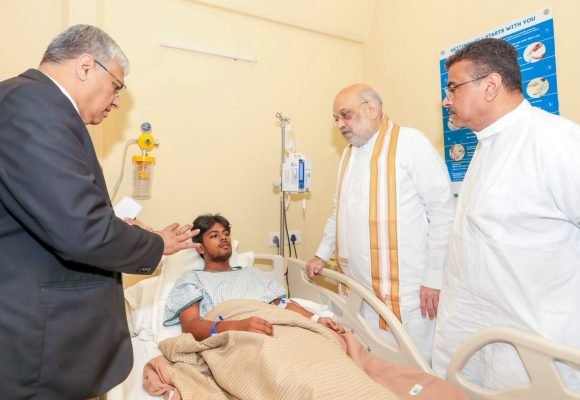
Amit Shah and Suvendu Adhikari Visit Hospital to Meet Kolkata Stampede Victims
Union Home Minister Amit Shah and West Bengal Chief Minister Suvendu Adhikari visited a Kolkata hospital to meet stampede victims and assured the injured of the best possible medical care and necessary assistance.
 OCT 18, 2026
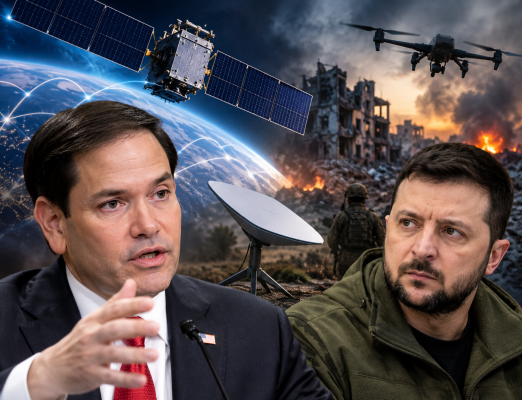
Rubio Clarifies US Position on Starshield for Ukraine
US Secretary of State Marco Rubio says the possible use of Starshield by Ukraine remains under discussion, distinguishing the military satellite system from SpaceX's commercial Starlink service.
 OCT 18, 2026
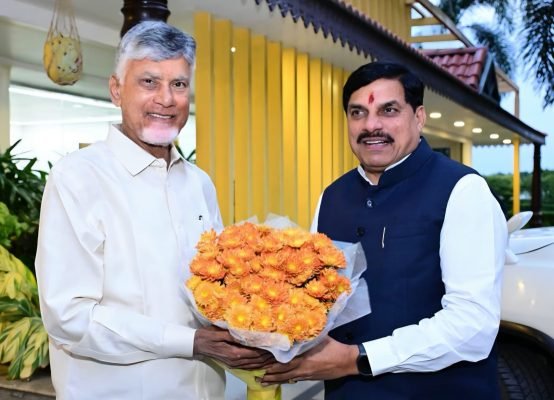
Mohan Yadav Meets Chandrababu Naidu, Reviews Amaravati Development
Madhya Pradesh Chief Minister Mohan Yadav met Andhra Pradesh Chief Minister N. Chandrababu Naidu to learn about development initiatives, including Amaravati’s construction. Nara Lokesh also presented him with a book on the Yuvagalam Padayatra.
 OCT 18, 2026
Canada Eyes Long-Term Trade Partnerships with India
Canada’s Trade Minister Maninder Sidhu has highlighted a $2.6 billion uranium supply agreement between Cameco and India while seeking stronger long-term business partnerships during the Team Canada Trade Mission reception in Mumbai.
Comments (0)