

WHO Chief Issues Urgent Appeal After Strikes Escalate Iran–Israel Nuclear Tensions
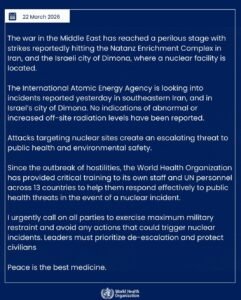 Amid the growing crisis, World Health Organization Director-General Tedros Adhanom Ghebreyesus issued a strong appeal for restraint, warning of the grave risks associated with military actions targeting nuclear facilities.
“Attacks on such sites pose a serious threat to public health and environmental safety,” he stated, emphasizing the potentially catastrophic consequences of any nuclear incident in an already volatile region.
Since the onset of hostilities, the WHO has proactively trained its personnel and United Nations staff across 13 countries to respond effectively to potential public health emergencies stemming from nuclear-related incidents. This preparedness effort underscores the seriousness with which global health authorities are treating the situation.
Tedros urged all parties involved to exercise maximum military restraint and prioritize de-escalation, stressing the need to safeguard civilian populations from the far-reaching impacts of conflict.
“Leaders must act responsibly to avoid triggering a nuclear crisis. Peace is the best medicine,” he added.
As geopolitical tensions continue to rise, the international community remains on high alert, closely watching developments that could have far-reaching consequences for regional stability, environmental safety, and global public health.
Amid the growing crisis, World Health Organization Director-General Tedros Adhanom Ghebreyesus issued a strong appeal for restraint, warning of the grave risks associated with military actions targeting nuclear facilities.
“Attacks on such sites pose a serious threat to public health and environmental safety,” he stated, emphasizing the potentially catastrophic consequences of any nuclear incident in an already volatile region.
Since the onset of hostilities, the WHO has proactively trained its personnel and United Nations staff across 13 countries to respond effectively to potential public health emergencies stemming from nuclear-related incidents. This preparedness effort underscores the seriousness with which global health authorities are treating the situation.
Tedros urged all parties involved to exercise maximum military restraint and prioritize de-escalation, stressing the need to safeguard civilian populations from the far-reaching impacts of conflict.
“Leaders must act responsibly to avoid triggering a nuclear crisis. Peace is the best medicine,” he added.
As geopolitical tensions continue to rise, the international community remains on high alert, closely watching developments that could have far-reaching consequences for regional stability, environmental safety, and global public health. Related News
 OCT 11, 2026
Suvendu Adhikari Leads Mahalaya Celebrations in Kolkata
West Bengal Chief Minister Suvendu Adhikari joined the colourful Mahalaya procession on Kolkata’s Red Road before presiding over the grand commencement of Durga Puja 2026 at Eden Gardens, featuring 3,000 dhakis, cultural performances and a spectacular drone show.
 OCT 11, 2026
Trump Says Zelenskyy Could Have Ended Ukraine War Several Times
US President Donald Trump has accused Volodymyr Zelenskyy of missing opportunities to end the Ukraine war and warned against attacks on refineries and diesel fuel infrastructure.
 OCT 10, 2026
Mithun Chakraborty Says ‘Fear-Free Bengal Has Truly Arrived’
West Bengal government cultural advisor Mithun Chakraborty said the large festive turnout in Kolkata showed that a “fear-free Bengal” had arrived.
 OCT 10, 2026
Suvendu Adhikari Praises Mahalaya Arrangements at Kolkata Ghats
West Bengal CM Suvendu Adhikari praised police, civic and river-security arrangements during Mahalaya, saying traditional Tarpan rituals passed peacefully across Kolkata’s ghats.
Comments (0)