

Jaishankar Warns of Global ‘Choke Points’ in Changing World Order
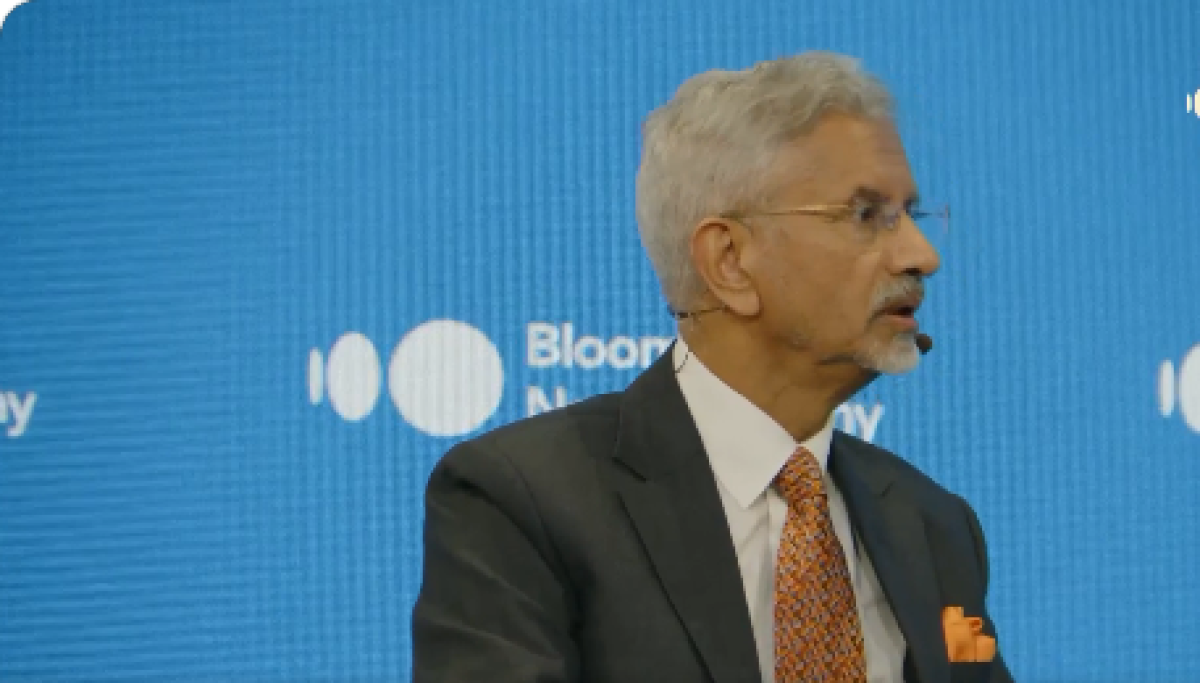
New Delhi: External Affairs Minister S. Jaishankar has highlighted the growing importance of strategic economic dependencies and global “choke points” amid changing international power dynamics. Speaking at the Bloomberg New Economy Forum in Delhi, he discussed how countries are increasingly competing over resources, financial systems and the ability to shape international trade and cooperation.
Jaishankar said the emerging global order is not defined only by the role of middle powers, but also by the influence countries can exercise through critical resources and systems.
Jaishankar Highlights Weaponisation of Economic Dependencies
Addressing the forum, Jaishankar said the tendency to weaponise economic relationships has become a significant feature of global competition.
While rare earth elements are often cited as an example, he noted that finance and sanctions can also function as strategic choke points.
His remarks highlighted how access to essential resources, financial channels and international economic systems can influence relations between countries.
Global Competition May Lead to New Partnerships
Jaishankar said international competition would increasingly depend on what different countries can contribute to negotiations and partnerships.
He described a changing environment in which nations could strike agreements based on complementary strengths, including commitments to develop projects together, expand trade and exchange resources or capabilities.
According to the minister, countries will continue to engage with one another, but the terms of cooperation and the relative influence of participants may change.
‘We Should Not Have a Pessimistic View’
Jaishankar urged against viewing the changing global landscape pessimistically. He said the process of change was already underway, although its direction had taken turns that many might not have anticipated.
He suggested that the evolving international order would reshape how countries interact, negotiate and form partnerships.
His remarks at the Bloomberg New Economy Forum underscored the importance of understanding shifting economic dependencies and adapting to new patterns of global cooperation and competition.
Related News
 OCT 14, 2026
India-US Relations Remain Strong and Will Improve Further, Says Piyush Goyal
Commerce Minister Piyush Goyal says India-US relations will continue to improve regardless of political changes, citing strong cooperation in trade, defence, technology and critical minerals. His remarks come amid ongoing negotiations on a bilateral trade agreement.
 OCT 14, 2026
Uttarakhand Gutkha Ban: Pushkar Singh Dhami Backs One-Year Prohibition
Dehradun: Uttarakhand Chief Minister Pushkar Singh Dhami has defended the state's one-year ban on the sale of gutkha, paan masala and tobacco products, saying the restrictions are reviewed annually and are intended to curb the harmful effects of addictive substances.
 OCT 14, 2026
Ashwini Vaishnaw Calls for Higher R&D Spending
Union Minister Ashwini Vaishnaw calls for increased R&D investment and application-oriented research, highlighting India's indigenous 4G telecom stack deployed across more than 100,000 towers through government-private sector collaboration.
 OCT 14, 2026
Abhijeet Dipke Calls CJP an Independent Pressure Group, Rules Out Party Registration
Cockroach Janta Party founder Abhijeet Dipke says the group will remain an independent pressure group and denies plans to register as a political party, while citing a common cause with the INDIA bloc.