

UPI Continues to Remain Free for Peer-to-Peer Transactions and 96% of Merchant Transactions
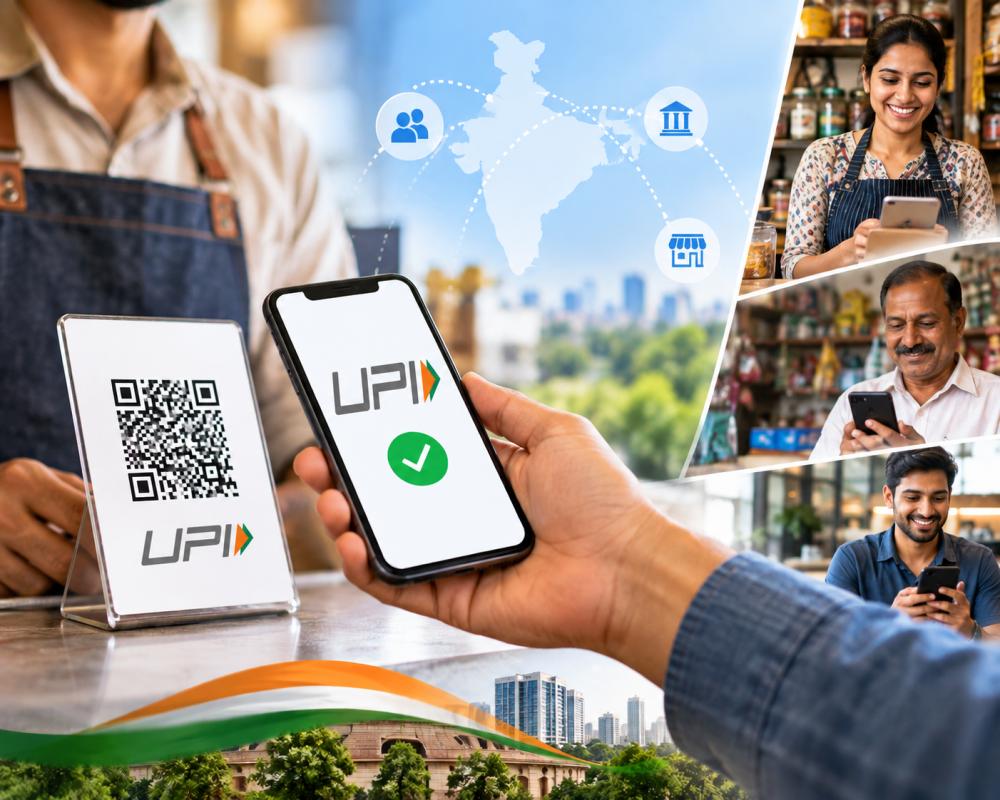
The proposed UPI Merchant Discount Rate (MDR) framework is designed to balance the long-term sustainability of India’s digital payments ecosystem with continued protection for individuals and small merchants.
👉 UPI Continues to Remain Free for Peer to Peer Transactions and 96% of Merchant Transactions
— Ministry of Finance (@FinMinIndia) September 15, 2026
👉 The new UPI framework introduced has no impact on any person to person transactions
👉 UPI will continue to remain completely free for all person-to-person transactions,… pic.twitter.com/lYVzehs6lU
According to the framework, MDR will apply to only around 4% of merchant transactions, meaning approximately 96% of merchant transactions will remain unaffected.
Daily UPI Transaction Limits Are Not Charging Thresholds
The daily transaction limits prescribed by banks and the National Payments Corporation of India (NPCI), generally ranging between ₹1 lakh and ₹5 lakh depending on the category, are intended as security and risk-management safeguards.
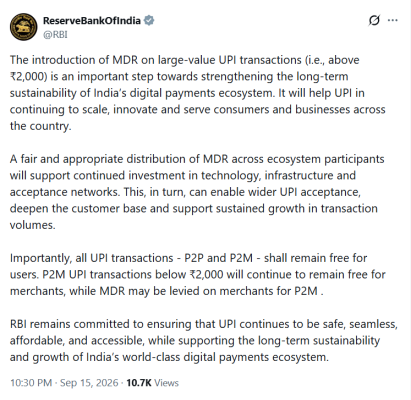
These limits should not be confused with charging thresholds under the MDR framework.
Most Merchant Transactions to Remain Unaffected
Data analysis indicates that MDR would apply to only a small proportion of merchant transactions. Around 96% of transactions will remain outside the impact, either because they fall below the ₹2,000 threshold or because they are covered under the zero-MDR framework applicable to small merchants.
The framework is therefore aimed at protecting individuals, micro-enterprises and small businesses while introducing a limited charge on larger merchant transactions.
Dedicated Support for Small Merchants
A dedicated fund is also proposed to promote wider UPI adoption among small merchants.
Under the framework, an amount equivalent to 5% of total MDR collections will be contributed to the fund. The money will support wider UPI acceptance, sustained usage and greater participation of small businesses in India's digital payments ecosystem.
Revenue to Strengthen UPI Infrastructure
The framework has been introduced under the Payment and Settlement Systems Act, 2007, following deliberations by the UPI Steering Committee concerning applicable rates, operational arrangements and consumer safeguards.
Revenue generated from larger merchant transactions is intended to support banks, payment service providers and UPI application providers in expanding and improving payment infrastructure, particularly in rural and semi-urban areas.
The approach is also aligned with the recommendation of the Standing Committee on Finance in its 32nd Report, which highlighted the importance of establishing a viable revenue model for the digital payments ecosystem.
What This Means for UPI Users
For the vast majority of consumers and small merchants, the framework is expected to have little or no impact on everyday UPI transactions. The stated objective is to maintain the convenience of UPI for individuals while creating a sustainable revenue mechanism around larger merchant transactions.
The broader aim is to ensure that UPI remains accessible, scalable and financially sustainable while continuing to drive India's transition towards a digital payments economy.
Related News
 OCT 27, 2026
Harry Kane Shares Heartfelt Message After Ballon d’Or Win
Harry Kane, Ballon d’Or, Harry Kane Ballon d’Or, Bayern Munich, England Football, Ballon d’Or Awards, Football News, Harry Kane Social Media
 OCT 27, 2026
Dutch Minister Sjoerd Sjoerdsma Hopes India-EU FTA Will Be Implemented by Spring 2027
The Netherlands’ Minister of Foreign Trade, Sjoerd Sjoerdsma, hopes the India-EU Free Trade Agreement will be signed in December and implemented by spring 2027, while noting that the timeline remains uncertain.
 OCT 27, 2026
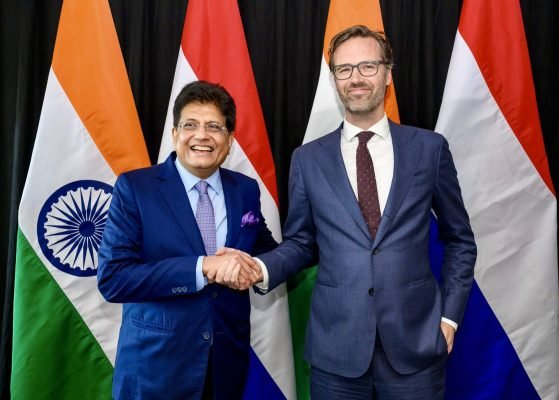
Piyush Goyal and Dutch Minister Sjoerd Sjoerdsma Discuss Trade, Investment and Clean Energy Cooperation
Union Minister Piyush Goyal and Dutch Minister Sjoerd Sjoerdsma discussed expanding bilateral trade, boosting Dutch investment in India and strengthening cooperation in semiconductors, green hydrogen, renewable energy and digital technologies.
 OCT 27, 2026
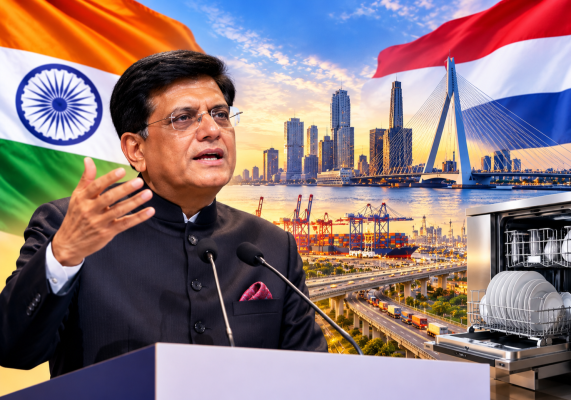
Piyush Goyal Sees Huge Opportunity in India-Dutch Trade
Union Minister Piyush Goyal has highlighted India's vast business opportunities for Dutch companies, predicting that India could sell more dishwashers in five years than the rest of the world combined. He also cited $130 billion in annual government infrastructure investment.