

Delhi AQI Nears Severe Mark After Diwali Celebrations
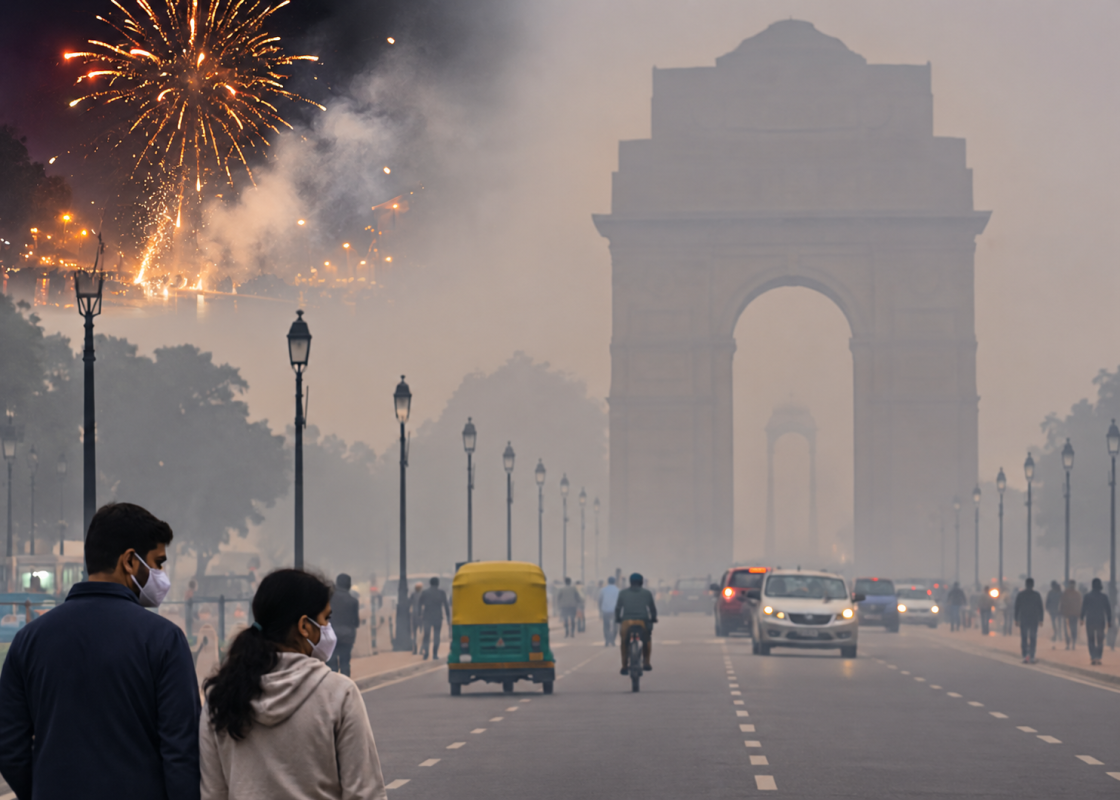
A thick blanket of grey haze enveloped the national capital on Monday morning, a day after Diwali celebrations, significantly reducing visibility and pushing Delhi's average Air Quality Index (AQI) to 370, close to the 'severe' category.
According to data from the Central Pollution Control Board (CPCB), Delhi's air quality remained in the 'very poor' category, with several monitoring stations recording 'severe' pollution levels. DTU and Burari Crossing registered the highest AQI at 437 each.
Four other monitoring stations recorded 'poor' air quality, while the remaining stations fell under the 'very poor' category. Areas including Bawana, Burari, Jahangirpuri, Sonia Vihar, Punjabi Bagh, Okhla and Rohini continued to experience severe pollution levels.
The Air Quality Early Warning System has warned that Delhi's air quality could deteriorate further and enter the 'severe' category during the day, with the situation likely to persist over the next few days.
Unfavourable weather conditions, vehicular emissions and stubble burning in neighbouring states are expected to contribute to the worsening pollution. According to the early warning system, a ventilation index below 6,000 square metres per second, combined with average wind speeds of less than 10 kmph, creates unfavourable conditions for the effective dispersal of pollutants.
Diwali Firecrackers Add to Delhi's Pollution Woes
Despite restrictions on firecracker use, bursting of firecrackers continued across the national capital on Diwali night, further worsening air quality.
As many as 20 monitoring stations recorded 'severe' air quality levels. Sonia Vihar registered the highest AQI at 463, followed by Jahangirpuri at 450.
Delhi's average AQI stood at 376 on Sunday. Of the 59 monitoring stations that reported data at 10 pm on Diwali, 20 recorded 'severe' pollution levels, six were in the 'poor' category and the remaining 33 registered 'very poor' air quality.
Firecracker activity intensified from around 5 pm to 6 pm on Sunday, with reports from areas including Pitampura, Burari, Mayur Vihar and parts of Lutyens' Delhi. As celebrations continued through the evening, thick smoke accumulated over roads and residential neighbourhoods, adding to the city's pollution burden.
CPCB's Air Quality Classification
The Central Pollution Control Board classifies the Air Quality Index into six categories:
Good: 0–50
Satisfactory: 51–100
Moderate: 101–200
Poor: 201–300
Very Poor: 301–400
Severe: 401–500
With Delhi's AQI hovering close to the severe threshold, the post-Diwali pollution crisis has once again raised concerns over public health and the city's air quality.
Related News
 NOV 9, 2026
'You're Amazing Man': Carlos Alcaraz's Heartfelt Praise for Ben Shelton
Carlos Alcaraz paid a heartfelt tribute to Ben Shelton after the Paris Masters final, praising the American's resilience, professionalism and champion mentality.
 NOV 8, 2026
Carlos Alcaraz Beats Ben Shelton to Win Maiden Paris Masters Title
Carlos Alcaraz defeated Ben Shelton 7-6(5), 7-5 to win his maiden Paris Masters title. The Spaniard claimed his ninth Masters 1000 crown, avenged his US Open defeat and extended his winning streak to nine matches.
 NOV 8, 2026
Rashmika Mandanna Shares Heartwarming Diwali Wishes
Actress Rashmika Mandanna shared a series of pictures from her Diwali celebrations, sending heartfelt wishes of happiness, good health, joy and endless love to her fans and their families.
 NOV 8, 2026
Israel President Gives Gadi Eisenkot Mandate to Form Government
Gadi Eisenkot has received the mandate from Israeli President Isaac Herzog to form the next government, pledging to establish a broad-based national emergency administration swiftly.